
Empath and Narcissist: The Hidden Dynamics of Emotional Feeding
In the field, it never looks like a “relationship,” but rather like a system of feeding and regulation.
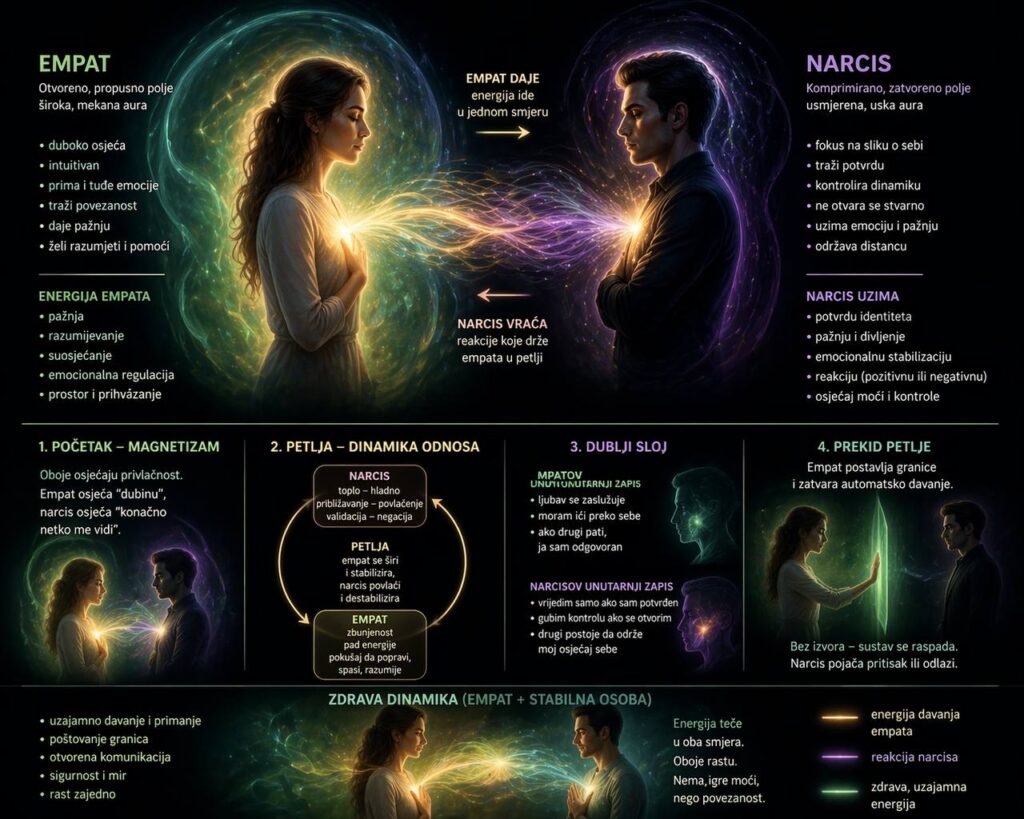
An empath enters openly. The heart center is wide, soft, permeable. Boundaries aren't rigid but living, and that's precisely where the entry point arises. He reads not just words but micro-movements, emotions, nuances. This makes him precise, but also vulnerable.
Narcissus does not enter openly. His field is compressed, focused on gaining validation and control. He has no deep connection to the heart but to the external image and reflection. He seeks not contact but resonance.
When they are joined, a junction is formed through which energy flows in one direction.
An empath provides attention, a sense of being seen, emotional regulation, and the capacity to hold another person's state.
Narcissist takes identity confirmation, emotional stabilization, a reaction (positive or negative, it doesn't matter), a sense of power.
At first it looks like magnetism. The empath feels “depth,” because they're actually sensing their own depth reflected through the narcissist. The narcissist feels “finally someone who sees me,” but that isn't seeing—it's supply.
Then the crucial break comes. The empath begins to feel confusion, a drop in energy, an increased need to explain, fix, save, and an inner restlessness that isn't his.
Narcissist begins making micro-shifts: hot–cold, approach–withdrawal, validation–denial.
That's no accident. It's a way to keep the empath's field open and active.
In the field, it looks like this: the empath expands and tries to stabilize, the narcissist withdraws and destabilizes.
And that's how a loop is created.
The deepest layer isn't in the narcissist but in the empath.
The empath has a record: love must be earned; I have to rise above myself; if someone else suffers, I am responsible.
That's why he stays, even when he sees what's happening.
Narcissist's record: I'm only valuable if I'm validated, I lose control if I open up, others exist to maintain my sense of self.
That's why it doesn't really matter.
When an empath starts to close the field, two things happen: the narcissist either ramps up the pressure (more games, more drama) or pulls back and looks for a new source.
That's why separation is never just physical but also energetic.
Healthy state isn't about the empath ceasing to feel, but about understanding that feeling doesn't mean automatic giving; someone else's emotion isn't their responsibility, and a boundary doesn't close the heart but protects it. An open heart but with solar plexus boundaries.
Once that's in place, the dynamics fall apart on their own.
Because without an open source, the system has nothing to feed on.
Narcissus only changes if he loses his source of supply and experiences the emptiness he carries, at which point his self-image collapses.
They share a common fear of losing their identity—“who am I if I don't give” and “who am I if I'm not given to.” A hidden contract in which the empath gives the narcissist their existence, and the narcissist gives the empath a sense of purpose.
That's why the breakdown of that relationship isn't just a separation but a shattering of identity. Through it, the empath learns to set boundaries without losing their heart, and the narcissist can, for the first time, experience real emotions if they stop seeking new sources of energy.
They live the same fear at opposite ends of the polarity.

 Croatian
  English